
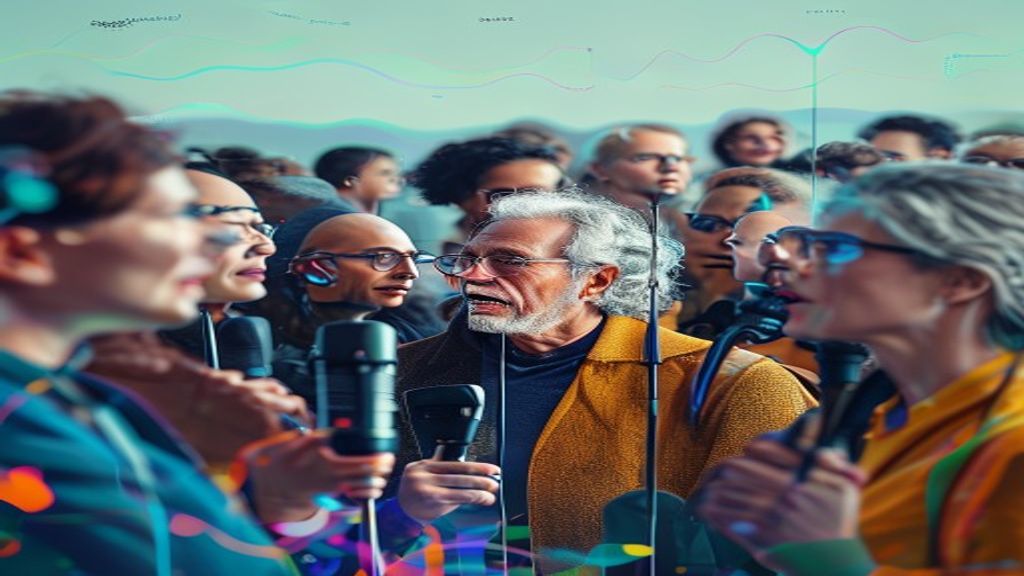
The increasing integration of Large Language Models (LLMs) into speech recognition systems raises crucial questions about their fairness, revealing that technological advancement does not always equate to greater inclusion.
What happened
Recent research, published on ArXiv under the title Do LLM Decoders Listen Fairly? Benchmarking How Language Model Priors Shape Bias in Speech Recognition, has deeply analyzed whether the adoption of LLM-based decoders for speech recognition leads to greater equity or more pronounced discrimination among different demographic groups. The study conducted a rigorous evaluation of nine speech recognition models, representing three distinct architectural generations: from CTC (Connectionist Temporal Classification) systems without an explicit language model, to encoder-decoders with an implicit language model, up to the latest LLM-based systems with a pre-trained decoder. For the evaluation, approximately 43,000 utterances were used, extracted from reference datasets such as Common Voice 24 and Meta's Fair-Speech, known for their demographic diversity.
The researchers examined the models' performance along five crucial demographic axes: ethnicity, accent, gender, age, and first language. The results revealed a concerning trend: despite the sophistication and linguistic understanding capabilities of LLMs, their integration into speech recognition systems can, in some contexts, introduce or even amplify biases already present in the training data. This occurs because the textual "priors"—the linguistic knowledge pre-acquired by LLMs during their training on vast text corpora—can prevail and negatively influence the accuracy and fairness of speech recognition for minority groups or those with vocal characteristics less represented in the training data. In essence, what makes LLMs powerful in understanding written language can make them less equitable in interpreting the diversity of spoken language.
Why it matters
The accuracy and fairness of speech recognition are fundamental pillars for digital accessibility and social inclusion. If LLM-based systems show significant biases towards specific accents, ethnicities, age groups, or first languages, the risk is to create a disparity in access to essential services and perpetuate implicit discrimination on a large scale. Consider the impact on sectors such as automated customer service, smart home devices, transcription applications for professionals or individuals with hearing impairments, and even security systems that rely on voice identification.
A system that struggles to understand a non-standard accent, the voice of an elderly person, or a regional dialect is not just less efficient; it erects a barrier to inclusion, marginalizing entire segments of the digital population. This problem transcends mere technical efficiency, touching upon deep issues of social justice and human rights. The perpetuation of stereotypes and inequalities through the uncritical use of technology can have a lasting social impact, eroding trust in AI and widening the digital divide for those already on the margins. The research underscores how technological "neutrality" is a myth, and that every design and training choice has concrete repercussions on people's lives.
The HDAI perspective
This research highlights an uncomfortable but crucial truth for our vision of ethical and human-centric AI: technological innovation, if not intrinsically guided by robust ethical principles and rigorous attention to human impact, risks generating more social problems than it solves. It is imperative that the development and implementation of LLM-based speech recognition systems prioritize demographic equity, transparency in evaluation processes, and the accountability of designers. It is not enough for a model to be "more powerful" or "higher performing" on aggregate metrics; it must also be "fairer" and inclusive for all users.
Companies and researchers must adopt more robust and inclusive testing methodologies that go beyond traditional overall accuracy metrics to granularly examine performance across specific demographic subgroups. This requires significant investment in collecting more diverse and representative training data and in developing advanced de-biasing techniques. AI governance must evolve to impose clear standards and audit mechanisms that ensure the benefits of these technologies are distributed equitably, without creating new forms of digital exclusion or reinforcing existing discrimination. The goal must be an AI that not only understands language but also respects and values the richness of human diversity.
What to watch
It will be crucial to closely monitor how major LLM providers and companies integrating them into their products address these findings. We expect a growing commitment not only to researching technical solutions to mitigate biases but also to adopting more conscious and responsible development practices. Transparency regarding training data and fairness evaluation methods will become an increasingly pressing requirement. Collaboration among researchers, developers, policymakers, and affected communities will be crucial to building speech recognition systems that are truly universal, inclusive, and respectful of the multiple voices that compose our society. The focus will increasingly shift from mere technical capability to the ability to serve humanity equitably.